REVIEW · VENICE
Venice: Entrance Ticket to the Naval Historical Museum
Book on GetYourGuide →Operated by D'Uva · Bookable on GetYourGuide
If you think Venice is only gondolas, think again. This is a ticket to the Naval Historical Museum of Venice (MUNAV), a 15th-century building packed with ship models, documents, and paintings tied to Italy’s maritime tradition; I especially like the way the exhibits cover everything from ancient Venetian boats to modern Italian Navy models, and I also love the standout collection of boats from China and the Far East. One thing to consider: it’s self-guided (no guided tour included), so you’ll rely on the signage and your own pace—fine for many people, but less ideal if you want a lot of storytelling from a guide.
You’ll find MUNAV close to the action. It’s about a 5-minute walk from Piazza San Marco, and it sits next to the Ancient Arsenal of Venice, so your museum time fits nicely into a classic Venice walking day without needing extra transit.
In This Review
- Quick hits before you go
- Entering MUNAV: walking in from San Marco and the Arsenal
- What’s inside: five floors across 6,000 square meters
- The core collection: models, artifacts, paintings, and documents
- The standout feature: boats from China and the Far East
- How long 1.5 hours really works on-site
- Skip-the-line entry: saving time in the San Marco area
- Price and value: is $18 worth it?
- A note on the museum experience: it’s self-guided
- Pets at MUNAV: what’s allowed
- Who should book this museum ticket
- A few words from verified bookings (and what they signal)
- Should you book MUNAV?
- FAQ
- Where is the Naval Historical Museum of Venice (MUNAV) located?
- How long should I plan for my visit?
- How much is the entrance ticket?
- What’s included with the ticket?
- Is a guided tour included?
- Can I skip the line?
- Is there free cancellation?
- Are small pets allowed inside?
Quick hits before you go
- San Marco area location: about a 5-minute walk from Piazza San Marco, next to the Ancient Arsenal of Venice
- Five floors, 6,000 square meters: a lot to see in a compact area
- Not just ships: models plus paintings and documents, so it’s more than “look at boats”
- Far East boat collection: an exceptional set of boats from China and the Far East
- Italian Navy / Defense connection: owned and managed through Italy’s defense institutions (Naval ties are real here)
- Skip-the-line entrance: separate entrance helps you start sooner
Entering MUNAV: walking in from San Marco and the Arsenal
MUNAV is easy to plug into a day in central Venice. The museum is roughly a 5-minute walk from Piazza San Marco, and it’s adjacent to the Ancient Arsenal of Venice. That matters because you’re not commuting across the city—you can do museum time and still have energy left for nearby streets and canals.
The museum sits in a 15th-century building that once functioned as the Serenissima Republic’s “Granary.” Even before you reach the exhibits, that setting gives the visit a sense of purpose: you’re walking inside a piece of Venetian infrastructure that supported the state, not a modern box slapped onto the lagoon.
You can also read our reviews of more tours and experiences in Venice



What’s inside: five floors across 6,000 square meters
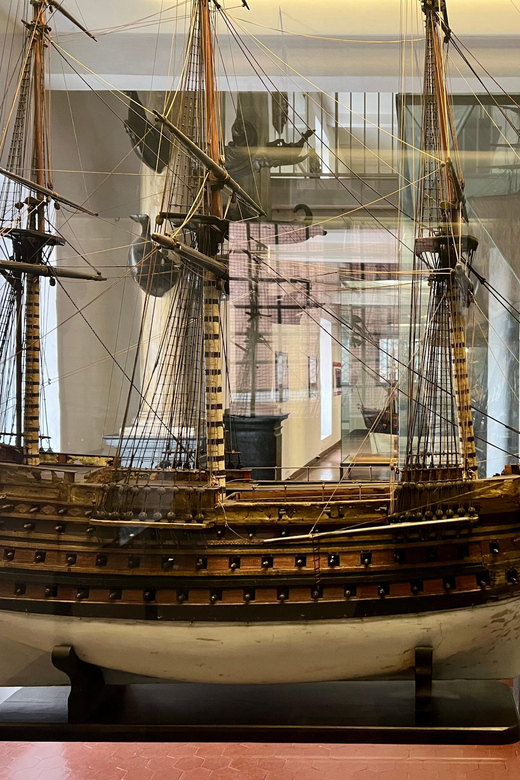
MUNAV spans about 6,000 square meters and uses a five-floor exhibition layout. That sounds like a lot (and it is), but it’s also why the ticket works well for different pacing styles. If you like scanning, you can cover major themes quickly. If you’re the type who reads labels, you’ll spend time on the details and still stay within your 1.5-hour target if you plan your route.
The exhibits are organized to tell a timeline of maritime power and technology. You’ll see material that links Venice’s early maritime roots to later developments, then continues forward into modern Italian Navy representations. In practice, that means the museum doesn’t feel stuck in the past—it keeps you moving from era to era.
The core collection: models, artifacts, paintings, and documents
This is the kind of museum where the “what” matters as much as the “when.” The main exhibition materials include:
- Historical artifacts
- Ship models
- Paintings
- Documents
I like that combination because it gives you multiple ways to connect. A ship model can explain design and scale. A painting can show how people wanted ships to be seen. Documents add context—who built what, and why it mattered. If you’ve ever wondered how navies think beyond sailing, this format helps you get there.
Also, because it’s a museum connected to the Italian Navy, the presentation feels intentionally structured around maritime identity. You get the sense that this isn’t just a hobby collection; it’s meant to preserve and communicate institutional heritage.
The standout feature: boats from China and the Far East
One of the most praised elements here is unusual in the best way: the museum includes an exceptional collection of boats from China and the Far East. That’s not the “standard Venice-only” storyline you might expect, and it’s a big reason the museum feels more international than many smaller city collections.
Why this matters for you: it widens the lens. Instead of treating Venetian maritime history like a closed loop, you’re looking at how different regions built and used boats. Even if you’re not a maritime nerd, you’ll likely notice the variety in design ideas and the plain fact that sea travel connected cultures far beyond the lagoon.
If you’re the type who likes a museum to surprise you once or twice, this is where it happens.
How long 1.5 hours really works on-site
The ticket experience is set for about 1.5 hours. For a five-floor museum, that’s both enough and not enough—depending on your style.
Here’s the reality: 1.5 hours usually means you’ll do a “highlights plus a few close reads” strategy. It’s not ideal if you want to read every document carefully across all five floors without skipping anything. It is ideal if you want to leave with a clear sense of how Venice’s naval story evolved and what the museum considers key artifacts.
My practical advice: pick two anchors before you start (for most people, those anchors are the Venetian-to-modern timeline and the China/Far East boat collection). Then let the rest of the floors fill in around them. That keeps you from feeling scattered.
You can also read our reviews of more historical tours in Venice






Skip-the-line entry: saving time in the San Marco area
You get skip-the-line access through a separate entrance. In a crowded area like San Marco, that difference can be meaningful. Instead of spending your limited museum time waiting, you spend it looking at models, artifacts, and exhibits.
I also like that the experience is built around a timed visit window (starting times depend on availability). It helps you manage expectations: you’re going in knowing you’ll have a set amount of time to explore, which makes it easier to pair with other nearby stops.
Price and value: is $18 worth it?
The price is listed as $18 per person. That’s a reasonable museum ticket for Venice, especially for a site that covers a lot of ground—five floors, 6,000 square meters, and multiple categories of display (models, paintings, and documents), not just one type of object.
The value angle for you depends on what you want:
- If you like museums that connect technology, politics, and everyday maritime life, $18 often feels fair because you get several content types and a timeline.
- If you only want a quick look at a few boats, you might wish you had a shorter route or a faster museum option—though the 1.5-hour duration still works if you focus on the key collections.
Also, since the museum is connected to Italy’s naval and defense institutions, you’re paying for access to a preservation-focused collection, not a small private display.
A quick reality check: with no guided tour included, your value comes from your willingness to read labels and follow the exhibit flow yourself.
A note on the museum experience: it’s self-guided
The ticket includes entry only—there’s no guided tour included. That’s not automatically bad; many people prefer self-paced museum time in Venice because you can slow down or move on without worrying about a group rhythm.
But it does change the best way to enjoy it. Go in ready to read. Expect to spend your attention on museum descriptions and exhibit context rather than having someone explain each item out loud.
To make it easier, I’d treat the visit like a themed walk:
- Track the progression of Venetian maritime identity.
- Use the China/Far East boats as your “wow” stop.
- Let the modern Italian Navy models act as your wrap-up.
Pets at MUNAV: what’s allowed
If you’re traveling with a small pet, the rules are fairly clear. Access to rooms and outdoor spaces is allowed with small pets if they are carried in their own carrier or in arms for the duration of the visit. Guide dogs for the visually impaired are exempt from this rule.
This is the kind of detail that can make or break a plan in Europe, so it’s worth knowing before you go.
Who should book this museum ticket
This is a good fit if you:
- Like museums with real context and multiple exhibit types (not only ship models)
- Want a Venice experience that goes beyond landmarks and postcards
- Enjoy maritime history, naval technology, or the idea of Venice as a state built around the sea
- Appreciate surprises—especially the Far East boat collection
It may be less ideal if you:
- Want a fully guided, talk-through experience (since guided tours are not included)
- Prefer very fast museum visits with minimal reading
A few words from verified bookings (and what they signal)
The overall rating is 4.7 out of 5 from 39 reviews, which lines up with the museum’s appeal as a serious, visitor-friendly stop.
- Sandra (Austria) rated it highly and called the museum beautiful and informative.
- A France booking rated it super for all audiences, which matches the idea that the museum works even if you’re not a maritime specialist.
- A United States booking highlighted how strongly it connects to Venetian history and praised the information on display.
Even without a guide included, those comments suggest the exhibits are readable and organized enough to satisfy general visitors—not just specialists.
Should you book MUNAV?
Yes, I’d book this ticket if you want a high-value museum stop that’s genuinely tied to Venice’s maritime identity and you like exploring at your own pace. The skip-the-line entrance helps you make the most of limited time near San Marco, and the five-floor layout gives you enough variety to feel like you saw more than one room.
I’d also book it if the China and the Far East boat collection sounds interesting to you—because that’s exactly the kind of feature that makes MUNAV more memorable than a typical naval display.
You might skip it only if you need a guided narrative to keep museums engaging, or if you’re only in Venice for super-short landmark hits. Otherwise, this is a smart, well-priced way to see a side of Venice you can’t get from photos alone.
FAQ
Where is the Naval Historical Museum of Venice (MUNAV) located?
It’s about a 5-minute walk from Piazza San Marco, and it’s adjacent to the Ancient Arsenal of Venice.
How long should I plan for my visit?
Plan for about 1.5 hours.
How much is the entrance ticket?
The price is listed as $18 per person.
What’s included with the ticket?
Your ticket includes entry to the museum.
Is a guided tour included?
No, a guided tour is not included.
Can I skip the line?
Yes. You can skip the line through a separate entrance.
Is there free cancellation?
Yes. You can cancel up to 24 hours in advance for a full refund.
Are small pets allowed inside?
Small pets are allowed in rooms and outdoor spaces if they are carried in their own carrier or in arms for the duration of the visit. Guide dogs are exempt.